EN
Posted on December 03, 2025
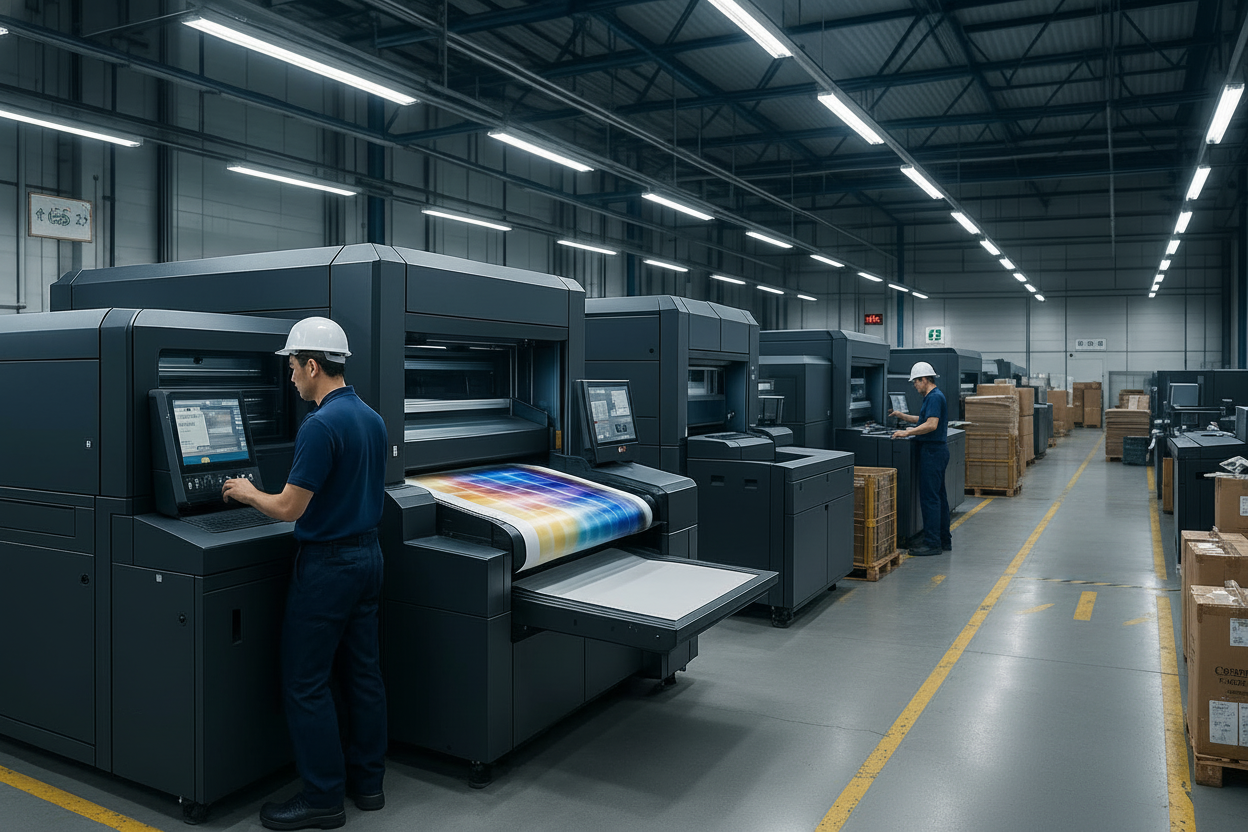
Digital inkjet printing machines are moving from “adjacent” to “essential” on packaging floors. In 2025, convergence is real: single-pass inkjet on flexible packaging, UV LED retrofits on legacy lines, and smarter heat transfer modules that integrate with MES/ERP. Why now? Three forces: speed-to-market, sustainability compliance, and labor shortfalls. For mid-size packaging manufacturers, the question isn’t if to digitize—it’s how to phase upgrades to hit ROI without disrupting OEE.
Inkjet heads and chemistry: Higher nozzle density, native 1200 dpi, and expanded gamut with low-migration, water-based inks for food packaging applications.
Screen printing persists: For high-opacity whites, metallics, and specialty varnishes on films and containers where tactile effects drive shelf impact.
Heat transfer goes modular: Faster platen heating, tighter temperature windows, and automated peel to stabilize yield on short-run SKUs.
Automation moves center stage: Closed-loop color, inline spectro, and AI-assisted RIP scheduling optimize small lots with minimal changeover.
CAPEX discipline: Modular frames, field-upgradable printbars, and subscription ink contracts can smooth cash flow.
Compliance by design: Food-contact compliance (FCM), low-migration inks, and energy-efficient curing to support 2025 sustainability reporting.
Workforce reality: Intuitive HMIs, codified job recipes, and remote diagnostics reduce operator training curves and unplanned downtime.
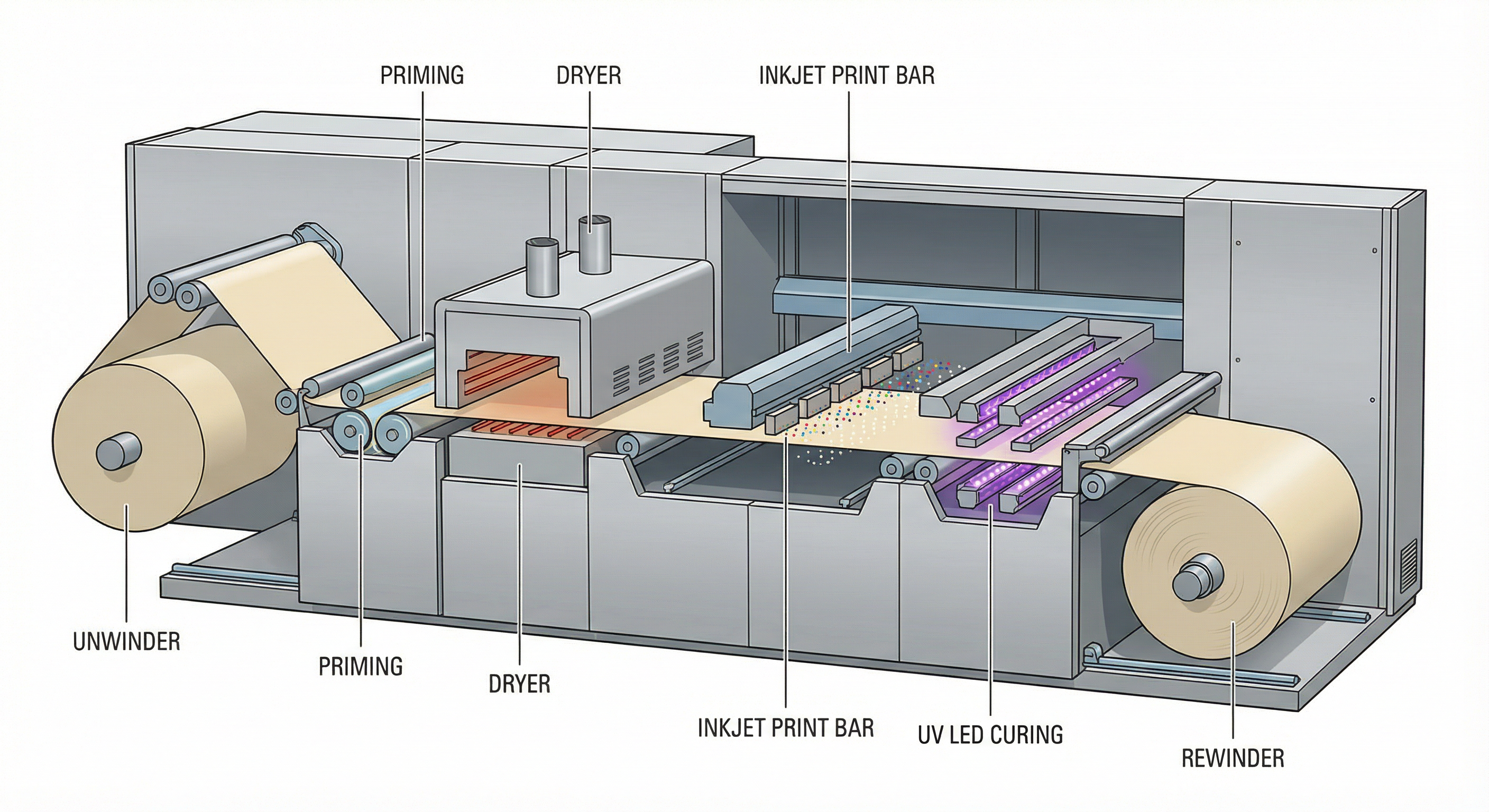
Single-pass: Best for high-volume, repeatable SKUs on paperboard and certain films; expect 50–150 m/min with inline priming and corona treatment.
Multi-pass: Flexible for prototyping and frequent design change; excels in CMYK+OGV branding and versioning with minimal waste.
Water-based pigment for flexible packaging and corrugate; pair with IR/hot-air and tuned primer for adhesion.
UV and UV LED for labels, shrink sleeves, and rigid containers where immediate handling and high scuff resistance are needed.
Low-migration ink sets for indirect food contact; validate against EuPIA and Swiss Ordinance positive lists.
Inline spectrophotometers with delta-E gating; reject logic tied to PLCs.
ICC/Multicolor profiles and G7 calibration to harmonize analog and digital.
Variable data printing (VDP) pipelines for serialization, anti-counterfeit, and micro-versioning.
Opacity and effects: High-build whites, metallics, and tactile varnishes that inkjet emulates poorly.
Substrate latitude: Glass, metal, and textured plastics for durable goods packaging and closures.
Hybrid lines: Screen for effects + inkjet for graphics/VDP, sequenced under one transport for register accuracy.
DTF/heat transfer for short-run labels, caps, and promotional add-ons tied to seasonal campaigns.
Newer platens with zoned heating reduce scorching on thin films; auto-peel improves cycle time consistency.
Good bridge for e-commerce pack-outs and late-stage customization without retooling.
Demand: FMCG and personal care with fast SKU turnover; cost-sensitive but growth-heavy.
Approach: Start with hybrid—retain screen for whites/effects, add mid-width multipass inkjet for graphics, and modular heat transfer for seasonal spikes.
Utilities: Prioritize UV LED retrofits for lower heat and energy bills; invest in training modules in local languages.
Demand: Short-run retail programs, club packs, and compliance-heavy food categories.
Approach: Single-pass inkjet on corrugate and paperboard for speed-to-shelf; pair with VDP for retail-DC localization.
Compliance: Emphasize low-migration inks and documented GMPs; customers expect auditable workflows.
Demand: Sustainability and recyclability; stronger regulatory guardrails.
Approach: Water-based inkjet on fiber-based substrates; energy audits favor UV LED and heat recovery.
Labels/film: Validate against Packaging and Packaging Waste Regulation (PPWR) targets; design for mono-material streams.
Predictive maintenance: Vibration and nozzle health scoring reduce unscheduled stops; parts replacement moves to planned windows.
Intelligent nesting and batching: RIPs group jobs by substrate/ink/finishing to cut makeready waste by double digits.
Vision and defect mapping: Cameras flag banding, color drift, and registration; auto-corrections feed back to printhead waveforms.
Data layer: OPC UA/MQTT connectors stream run data into MES for OEE and carbon reporting.
Payback horizon: 18–36 months typical for mid-speed inkjet when analog changeovers exceed 6 per shift.
Cost stack: Ink/consumables 35–55% of variable cost; energy drops 20–40% with UV LED vs. mercury lamps.
Waste: Digital first-article waste often under 2% vs. 8–12% on short-run analog; rework declines with closed-loop color.
Throughput: Late-stage customization eliminates plate/screen cycles; line-side VDP unlocks retail promotions without overprints.
Substrates: Films (BOPP, PET), paperboard, corrugate—confirm primers and surface energy.
Speeds and resolution: Match duty cycle; verify native vs. apparent dpi.
Ink compliance: Certificates for FCM where relevant; migration testing.
Curing: IR/hot air profiles for water-based; UV LED wavelengths and dose consistency.
Transport: Vacuum belts, pinning lamps, and web guiding for registration-critical work.
Connectivity: OPC UA, REST APIs, and job-ticketing compatibility with your MIS/ERP.
Phase 1 (0–3 months): Pilot cell with multipass inkjet and heat transfer; build SOPs, color standards, and operator certification.
Phase 2 (4–9 months): Integrate inline inspection, automate job recipes, and extend to two shifts; start VDP pilots.
Phase 3 (10–18 months): Add single-pass for core SKUs; decommission redundant analog steps; formalize predictive maintenance.
Ink migration risk: Co-develop with ink vendor; run migration/sensory tests early.
Nozzle outs and banding: Budget for head maintenance kits and train on waveform tuning.
Change management: Pair technical rollout with incentives and clear role definitions.
Vendor lock-in: Favor open controllers and documented APIs; negotiate exit clauses in ink contracts.
Use cases: Club pack versioning, retailer-specific promo flashes, multilingual artwork.
Hybridization: Screen for specialty layers, heat transfer for late-stage personalization, inkjet for core graphics.
Metrics that matter: OEE, makeready minutes per job, waste %, delta-E pass rate, and energy per square meter.
Digitization isn’t a bet on unproven tech anymore; it’s operational insurance. Start small, scale fast, and instrument everything. The plants that blend digital inkjet, screen effects, and heat transfer agility—backed by automation—will out-iterate competitors and win the shelf.