
In today's competitive manufacturing landscape, especially for mid-size packaging firms looking to expand, the pressure on procurement managers to make sound capital investments has never been greater. When evaluating new printing equipment—be it for digital inkjet, screen printing, or heat transfer applications—it's tempting to let the initial purchase price dominate the decision. However, this is a critical misstep. The true financial impact of such an investment extends far beyond the initial invoice. For a holistic and accurate assessment, understanding the printing machine TCO (Total Cost of Ownership) is not just beneficial; it's essential for long-term profitability and a sustainable competitive edge. This guide provides a strategic framework for analyzing TCO, calculating a realistic printing equipment ROI, and making an investment that pays dividends for years to come.
Why Total Cost of Ownership is the Only Metric That Matters in 2025
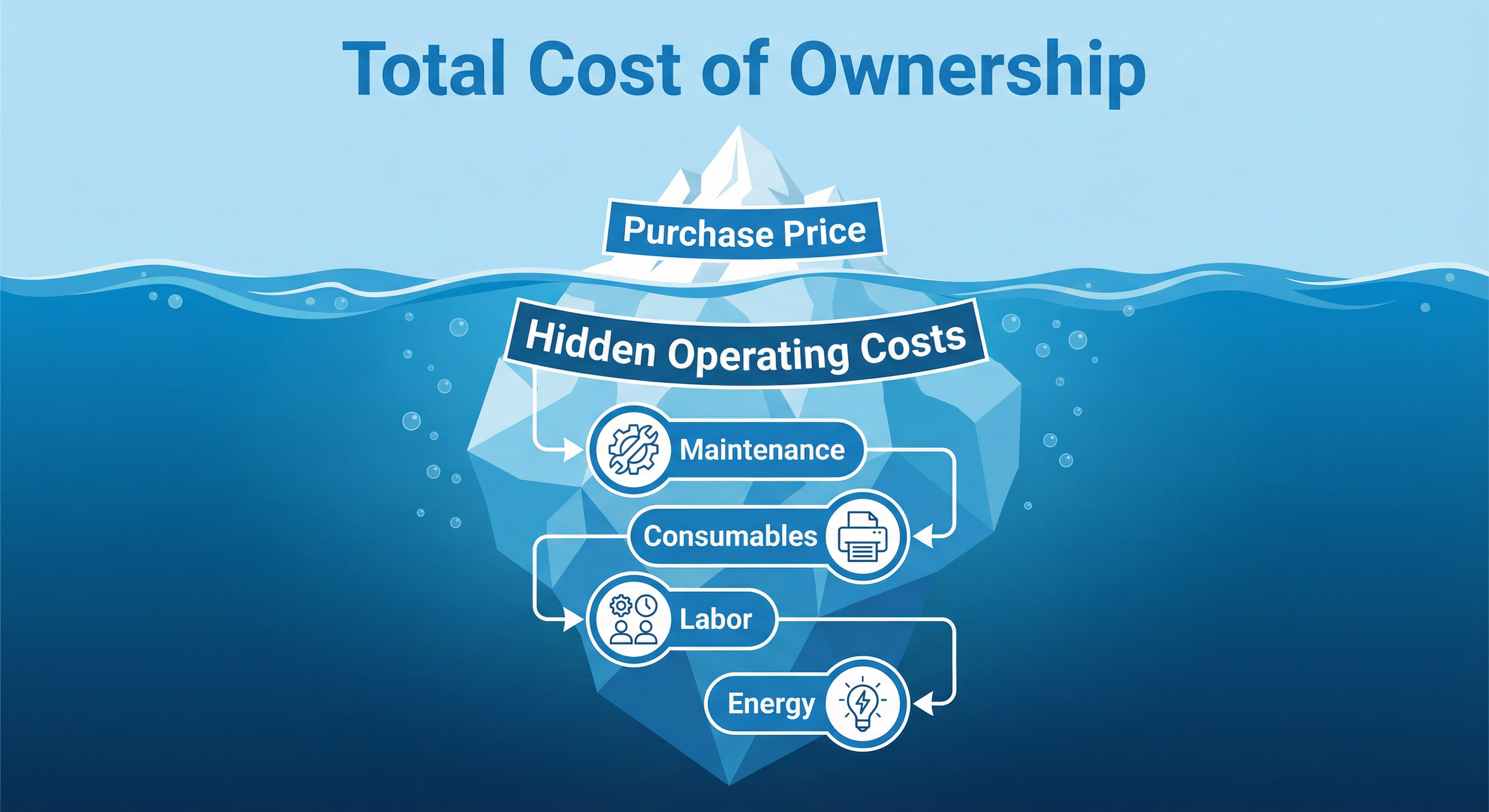
Think of a new printing machine as an iceberg. The sticker price is the visible tip, but the vast, submerged portion represents the ongoing operational costs that will accrue over the asset's entire lifecycle. TCO provides a complete financial picture by encompassing all direct and indirect expenses: Purchase Price + Operating Costs - Resale Value. Focusing solely on the initial CapEx can lead to purchasing a machine that, while cheaper upfront, bleeds the company dry through exorbitant maintenance, high consumable costs, or excessive downtime. In fact, industry analysis consistently shows that operating costs can amount to 3-5 times the initial purchase price over the life of the equipment [1]. For a mid-size packaging manufacturer, mastering TCO analysis is the key to unlocking true operational efficiency and maximizing profitability.
Deconstructing Printing Machine TCO: A Component-by-Component Analysis
A thorough TCO analysis requires a granular breakdown of every associated cost. By dissecting these components, procurement managers can build a precise financial model for each potential machine, enabling a true apples-to-apples comparison.
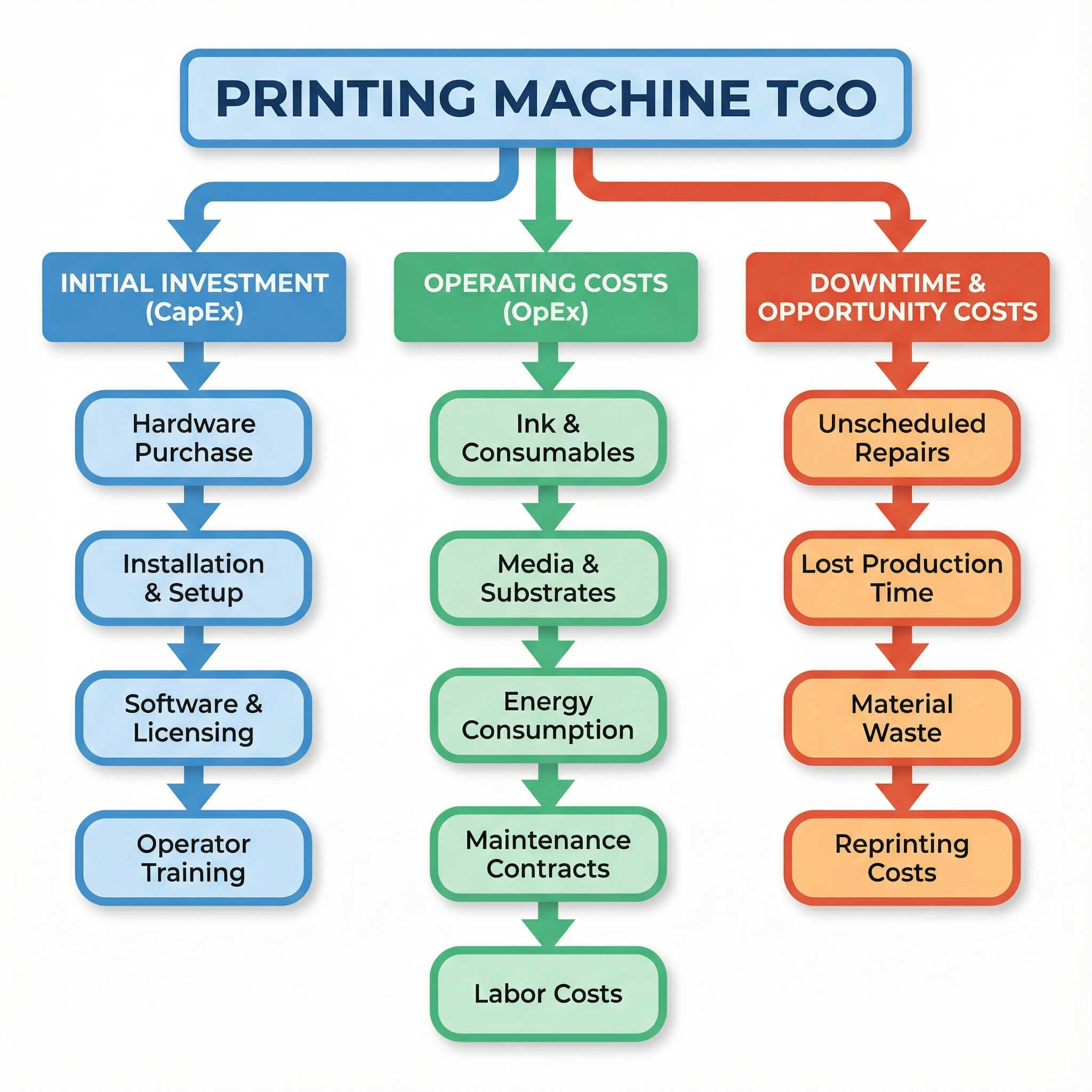
1. Initial Investment (CapEx)
This is the most straightforward component, but it's more than just the machine's price. It includes:
•Base Equipment Cost: The negotiated price of the machine itself.
•Ancillary Equipment: Pre-press systems, curing/drying units, post-press finishing equipment.
•Shipping & Installation: Freight charges, rigging, and professional setup fees.
•Initial Training: Costs associated with getting your team proficient on the new system.
2. Operating Costs (OpEx) - The Hidden Killers
This is where the bulk of the TCO lies and where diligence pays off. These costs are recurring and can vary dramatically between technologies and models.
|
Operating Cost Category
|
Digital Inkjet Considerations
|
Screen Printing Considerations
|
Heat Transfer Considerations
|
|
Consumables
|
Higher cost per ml of ink, but no screens or emulsions. Ideal for short runs.
|
Lower ink cost for high volumes, but add costs of screens, emulsion, and cleaning chemicals.
|
Requires transfer paper/film and specialty inks (e.g., sublimation), which can be costly.
|
|
Energy Consumption
|
Generally more efficient on a per-job basis for short to medium runs. Look for ENERGY STAR ratings.
|
Presses and large conveyor dryers can have high energy demands, especially during long runs.
|
Heat presses are energy-intensive; consumption depends heavily on cycle time and temperature.
|
|
Labor & Training
|
Faster setup, automated workflows. Lower skill threshold for operators.
|
Requires skilled labor for screen prep, setup, and color matching. Longer setup times.
|
Moderate skill required. Labor is tied to the manual process of applying transfers.
|
|
Maintenance & Repairs
|
Often involves service contracts. Potential for costly printhead replacement.
|
Mechanically robust, but requires regular cleaning and part replacement (squeegees, flood bars).
|
Fewer moving parts, but heating elements and control units can fail. Check warranty and parts availability.
|
3. Downtime & Opportunity Cost
What is the cost to your business when a machine is not running? This is a critical, often overlooked, component of TCO. A cheaper machine with poor reliability or slow support can quickly become the most expensive asset on your floor. When evaluating vendors, scrutinize their support structure, parts availability in your region (North America, Europe, Southeast Asia), and average response times. Every hour of unplanned downtime is an hour of lost revenue and potential damage to client relationships.
Calculating ROI: Turning Your Printing Equipment into a Profit Center
With a clear picture of your printing machine TCO, you can now accurately calculate the Return on Investment (ROI). The formula is simple, but the inputs must be robust:
ROI (%) = (Net Profit / Total Cost of Ownership) x 100
Net Profit is the revenue generated by the machine minus its operating costs. The key is to realistically project that revenue.
Revenue Generation Factors
•Speed, Throughput, & Automation: How does the machine's speed impact job completion rates? Automation features, as seen in modern presses like the GAUNTLET® 4, reduce setup times and increase repeatability, directly boosting throughput [2].
•New Market Opportunities: This is crucial for packaging manufacturers. Can the new machine print on thicker substrates, offer variable data printing for personalization, or handle unique finishes? A digital press, for instance, can unlock profitable short-run, high-customization jobs that are impractical for screen printing.
•Waste Reduction: Precision engineering and features like automated registration minimize misprints and substrate waste, directly improving the bottom line on every job.
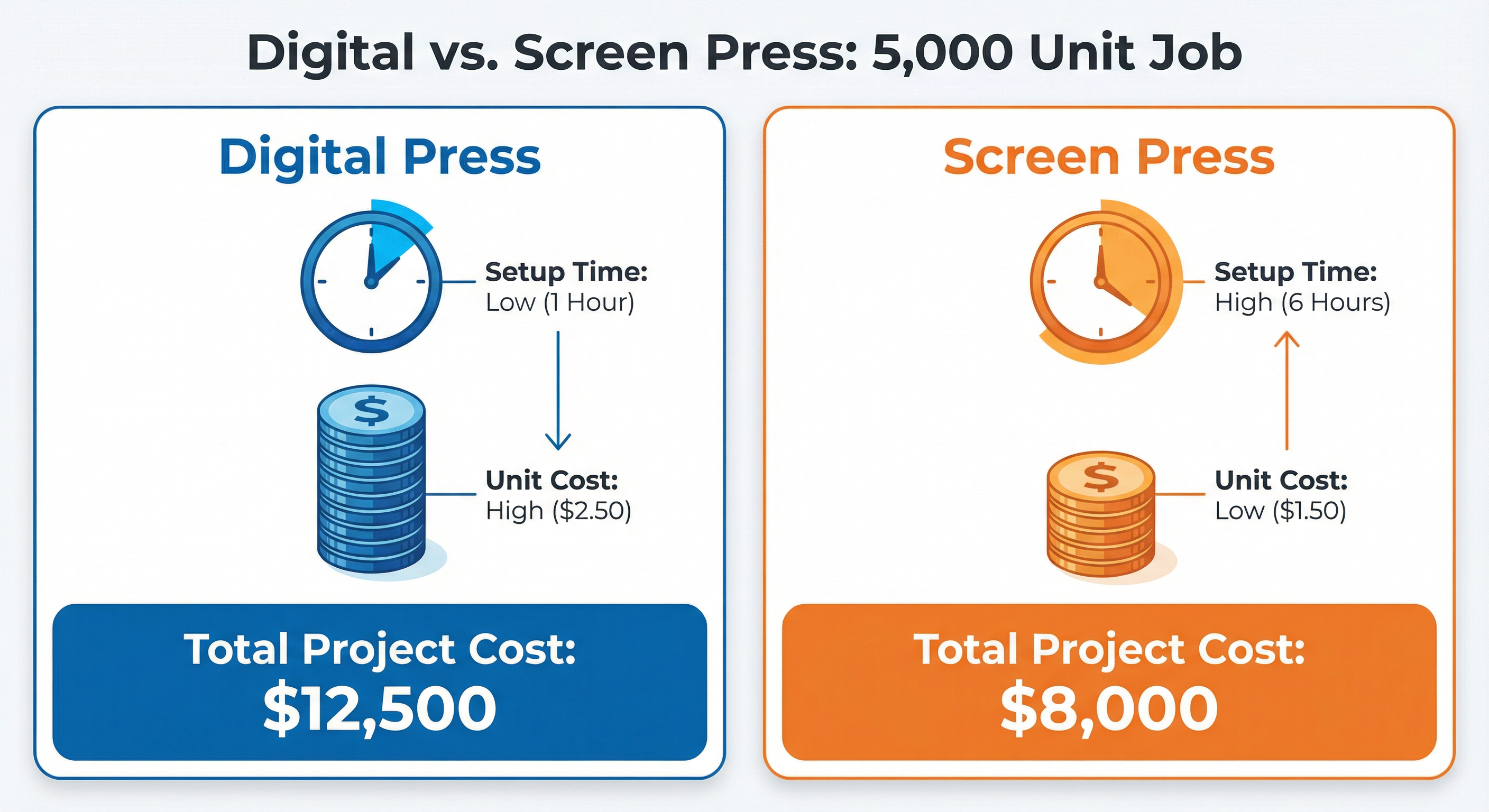
A Practical ROI Scenario: 5,000 Custom Boxes
Let's compare a hypothetical run of 5,000 custom-printed boxes on a new digital press versus a traditional screen printing press for a packaging firm.
|
Metric
|
High-End Digital Press
|
Automatic Screen Press
|
|
Setup Time
|
20 minutes
|
2.5 hours
|
|
Cost Per Unit (Ink + Labor)
|
$0.35
|
$0.15
|
|
Total Run Time
|
~4 hours
|
~2 hours (post-setup)
|
|
Total Project Cost
|
$1,750 (materials) + Labor
|
$750 (materials) + Labor
|
|
Key Insight
|
Higher unit cost, but incredible speed-to-market and ideal for variable designs.
|
Lower unit cost, but high setup time makes it inefficient for anything but repeat, high-volume orders.
|
What this shows is that for a one-off custom job, the digital press offers a faster turnaround, justifying a higher price point and potentially delivering a quicker ROI despite higher per-unit costs. For a recurring, high-volume order, the screen press becomes the ROI champion. The right choice depends entirely on your business model.
Strategic Sourcing for High ROI: A Procurement Manager's Checklist
Armed with TCO and ROI frameworks, the final step is strategic sourcing. This moves the conversation from "What's the price?" to "What's the value?"
1.Define Your Application Needs First: What substrates, volumes, and level of customization do you really need for the next 3-5 years? Don't buy a 10-color press if 95% of your jobs are 2-color.
2.Demand a TCO Analysis from Vendors: Make suppliers do the homework. Ask for detailed projections on ink consumption, energy usage, and expected maintenance costs. Challenge their assumptions.
3.Investigate Reliability and Support: Talk to existing users. How is the after-sales support? How quickly can they get a technician or parts to your location, whether it's in Indiana, Germany, or Vietnam? This is a non-negotiable part of the printing equipment ROI.
4.Consider the Entire Workflow: The machine is one part of a system. How does it integrate with your pre-press and post-press processes? A bottleneck in another area can nullify the speed of your new press.
5.Future-Proof Your Investment: As the industry continues its shift from analog to digital, consider modularity and upgradeability [3]. Can the machine be upgraded later to enhance its capabilities? This extends its useful life and protects your investment.
Conclusion: Making the Smartest Investment
For procurement managers at mid-size packaging manufacturers, selecting the right printing machinery is a strategic decision with long-term financial consequences. By moving beyond the initial price and embracing a rigorous printing machine TCO analysis, you can accurately forecast the true cost and, more importantly, the potential ROI of your next investment. The market in 2025 and beyond will reward those who can balance cost, efficiency, and the flexibility to seize new opportunities. By using this framework, you are not just buying a machine; you are investing in a core component of your company's future success.
Frequently Asked Questions (FAQ)
Q1: What is the most significant hidden cost in printing machine TCO?
A1: While it varies by application, unplanned downtime is often the most significant hidden cost. It halts production, delays orders, and can damage customer trust, making machine reliability and vendor support critical factors in TCO analysis.
Q2: How do I calculate the resale value of a printing machine?
A2: Research the used equipment market for similar models. Brands known for durability and long-term manufacturer support typically retain a higher resale value. Factor this into your TCO calculation as a final credit against the total cost.
Q3: Is a service contract worth the cost?
A3: In most cases, yes. A comprehensive service contract provides predictable maintenance costs, minimizes downtime, and often includes priority support. It's a form of insurance that protects your much larger investment and is a key part of managing your printing equipment ROI.
Q4: How long should I expect a printing machine to remain profitable?
A4: Most printing equipment has a useful life of 5-10 years, depending on technology and usage intensity. Digital presses may have shorter lifecycles due to rapid technological advancement, while screen presses tend to remain viable longer. Factor this into your TCO projections.
Q5: Should I lease or buy printing equipment?
A5: Leasing can reduce upfront capital requirements and provide flexibility for technology upgrades, but buying typically offers better long-term ROI if your business model is stable. Conduct a TCO analysis for both scenarios to determine which aligns with your financial strategy.