EN
Posted on December 04, 2025
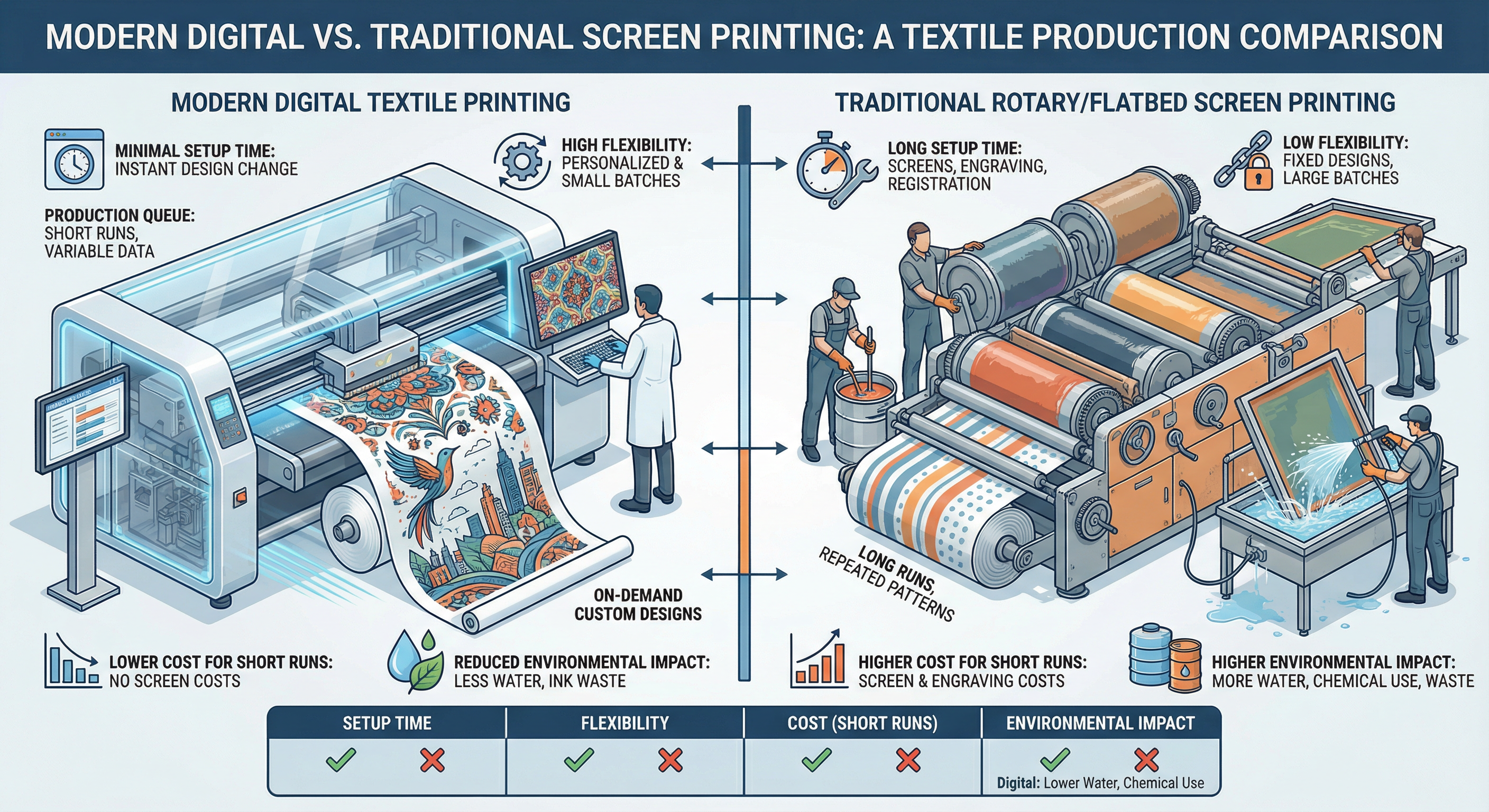
The textile printing landscape barely resembles what it looked like five years ago. Walk into a modern fabric printing facility today, and you'll find digital inkjet systems running alongside traditional screen printing equipment, heat transfer machines handling custom athletic wear, and hybrid workflows that would've seemed impossibly complex in 2019. This isn't gradual evolution—it's fundamental transformation driven by consumer demand for personalization, sustainability pressures, and economic realities that make small-batch production increasingly viable.
What's driving this shift? The numbers tell part of the story: the global digital printing market is expected to reach $57 billion by 2033, with textiles representing one of the fastest-growing segments. But statistics don't capture the operational reality that textile businesses face daily—orders getting smaller, turnaround expectations compressing, and customers demanding design flexibility that conventional methods simply can't deliver at reasonable costs 45454.
This article examines seven specific digital textile printing applications where businesses have successfully deployed modern printing technologies to solve concrete production challenges. These aren't theoretical use cases or vendor marketing scenarios. They're real-world implementations that demonstrate how digital inkjet printing machines, automated screen printing systems, and heat transfer equipment address the operational constraints textile printers actually encounter. 1
The fast fashion model has fundamentally restructured textile printing economics. Traditional workflows built around 5,000-piece minimum orders collapse when retailers demand 300-unit test runs delivered within 10 days. Digital textile printing solutions have emerged as the only economically viable response to this production reality.
A mid-size textile printer in Vietnam illustrates the transformation. Prior to 2023, the company operated six manual screen printing stations handling orders from regional apparel brands. Minimum order quantities sat at 2,000 pieces per design, with 14-day lead times from artwork approval to finished goods. When their largest customer—a Bangkok-based fashion retailer—requested the capability to print 500-piece runs with 7-day turnaround, the economics didn't work. Setup costs for screen printing consumed 40% of revenue on small runs, destroying margins.
The solution involved installing two digital textile printers capable of direct-to-fabric printing on cotton and polyester blends. The results reshaped their business model:
More importantly, the capability shift opened previously inaccessible market segments. The company now serves independent designers testing concepts before committing to larger screen-printed production runs, subscription box companies requiring frequent design rotations, and boutique brands operating on limited capital. Revenue from orders under 500 pieces—essentially zero in 2022—represented 34% of total sales by Q3 2024.
The lesson here isn't that digital textile printing applications replace screen printing entirely. The same company still runs high-volume orders through screen printing equipment that delivers superior economics at scale. It's that having both capabilities creates flexibility to serve diverse customer segments profitably. In practice, they use digital systems for runs under 800 pieces and design prototyping, while screen printing handles volume production above 1,200 units.
Athletic wear represents one of the most technically demanding textile printing applications. Performance fabrics like moisture-wicking polyester, compression materials, and technical blends require printing solutions that maintain fabric characteristics while delivering durable, vibrant graphics that survive repeated washing and high-stress use.
A European sportswear manufacturer specializing in custom cycling jerseys faced this exact challenge. Their customer base—amateur cycling clubs, corporate team-building events, and charity ride organizers—typically ordered 25-150 jerseys per design. Traditional sublimation printing worked technically but required outsourcing to specialized providers, creating 21-28 day lead times and limiting design iteration flexibility.
The company evaluated three technology pathways: direct-to-garment (DTG) digital printing, dye-sublimation with in-house equipment, and hybrid screen printing with heat transfer finishing. After analyzing their specific production mix and customer requirements, they implemented a dye-sublimation system combining digital printing with heat transfer presses.
This textile printing solution delivered several operational advantages:
Color Vibrancy and Durability: Dye-sublimation chemically bonds with polyester fibers rather than sitting on the surface, creating graphics that don't crack, peel, or fade even after 100+ wash cycles. Customer returns for print quality issues dropped from 3.2% to 0.4% post-implementation.
All-Over Printing Capability: Unlike traditional screen printing limited to front, back, and sleeve graphics, sublimation enables complete garment coverage including seams and edges. This opened premium product lines priced 40-60% higher than standard printed jerseys, with 75% of customers selecting all-over designs despite the premium.
Rapid Turnaround for Custom Orders: With digital file preparation and in-house production, lead times compressed to 5-7 days from artwork approval to shipping. This speed advantage won contracts with event organizers requiring last-minute custom gear, generating $180,000 in incremental 2024 revenue from orders the company couldn't previously accommodate.
Simplified Inventory Management: Rather than stocking pre-printed inventory and risking unsold stock, the company shifted to printing on-demand from blank garment inventory. This reduced working capital requirements by approximately $85,000 while eliminating closeout losses on discontinued designs.
The implementation wasn't without challenges. Polyester-specific sublimation limited their addressable market since cotton and cotton-blend applications required different technology. They solved this by maintaining DTG capability for cotton products, creating a technology portfolio matched to fabric types rather than a single-solution approach.
What's interesting is how customer behavior shifted post-implementation. With lower minimums and faster turnaround, average order frequency increased 2.3x while average order value decreased 35%. Total revenue, however, grew 47% because the company captured smaller, more frequent orders from budget-conscious customers previously priced out of custom apparel markets.
The home décor sector has experienced explosive growth in customization demand, particularly in North American and European markets where consumers increasingly view interior design as personal expression rather than standardized decoration. This trend creates substantial opportunity for textile printers capable of producing custom curtains, upholstery fabrics, throw pillows, and wall hangings in small quantities.
A North American textile printing business originally focused on commercial hospitality clients—hotels, restaurants, corporate offices—recognized this consumer trend in early 2023. Their traditional business model involved large-format screen printing for commercial projects averaging 800-2,000 meters per design. The consumer home décor opportunity required entirely different capabilities: orders of 5-50 meters, virtually unlimited design variation, and integration with e-commerce platforms enabling direct consumer ordering.
The company implemented a hybrid production strategy combining digital inkjet printing for custom consumer orders with retained screen printing capacity for commercial volume work. The digital fabric printing implementation specifically targeted:
E-commerce Integration: Direct connection between their Shopify storefront and digital printing workflow, enabling consumers to upload designs, preview fabric applications, and place orders without human intervention. This automation reduced order processing costs by 73% compared to their commercial B2B workflow.
Sample and Prototype Production: Interior designers and decorators could order 1-meter samples in any custom design for $45-65, enabling client presentations without committing to full yardage. This sample business generated $120,000 in 2024 revenue while serving as a lead generation channel for larger orders.
On-Demand Production Eliminating Inventory: Rather than the commercial model's inventory of printed yardage awaiting customer orders, the consumer business printed only confirmed orders. This eliminated inventory carrying costs and obsolescence risk while enabling infinite design variety.
Vertical Integration with Finishing: Adding automated cutting and sewing capabilities allowed the company to deliver finished products—sewn curtain panels with grommets, pillow covers with zippers, upholstered cushions—rather than printed yardage requiring customer finishing. Finished goods commanded 180-240% margins compared to 45-60% on printed fabric alone.
The financial results exceeded projections. Consumer home décor revenue reached $890,000 in the first 18 months, representing 23% of total company revenue despite requiring only one full-time production employee and seasonal part-time staff during peak periods. Perhaps more importantly, the business proved resilient during commercial construction slowdowns in late 2024 when hospitality project pipelines thinned.
The technology choice—aqueous pigment inkjet systems rather than reactive dye printing—proved critical. Pigment inks delivered the wash-fastness home textiles require while eliminating the environmental complications and wastewater treatment requirements of reactive dye systems. For a business serving consumers increasingly conscious of environmental impact, the ability to promote water-efficient, low-chemical printing processes became a marketing advantage worth approximately $50,000 in premium pricing across the customer base.
Corporate promotional products represent a $24 billion annual market in North America alone, with textile items—branded t-shirts, tote bags, caps, jackets—comprising roughly 40% of spending. This sector demands capabilities most textile printers don't naturally possess: extremely small run quantities (often 25-100 pieces), extremely tight deadlines (2-3 day rush orders common), and extremely wide product variety (printing on dozens of different garment types, fabrics, and colors).
A U.S.-based textile printer traditionally serving the uniform market identified promotional products as a growth opportunity but recognized their screen printing infrastructure couldn't economically serve the segment. Their solution involved deploying multiple complementary technologies matched to specific product categories and order characteristics.
Digital Inkjet for Cotton Promotional Items: DTG printers handling t-shirts, tote bags, and canvas products in quantities from 12 to 300 pieces. The company installed four DTG units capable of processing 60-80 garments per hour, creating sufficient throughput for promotional order volumes while maintaining 24-48 hour turnaround.
Heat Transfer Systems for Technical Fabrics: Performance jackets, moisture-wicking polo shirts, and technical caps require heat-applied transfers rather than direct printing due to fabric characteristics and construction methods. The company deployed six heat presses with digital print capability for transfer production, handling specialty items that DTG couldn't accommodate.
Screen Printing for Volume Orders: Promotional orders exceeding 500 pieces still flowed through automated screen printing lines where setup costs amortized across larger quantities, delivering cost per piece 40-60% below digital alternatives.
This multi-technology approach created operational complexity but delivered market-leading capabilities. The results after 24 months of operation:
The success factor wasn't technology alone—it was workflow integration. The company implemented production management software routing orders to appropriate equipment based on quantity, fabric type, and delivery deadline. A 75-piece cotton t-shirt order with standard lead time automatically queued for DTG printing. The same order marked rush with 48-hour delivery routed to screen printing if capacity existed, or DTG with overtime labor if necessary. A 600-piece performance polo order bypassed digital systems entirely, flowing straight to screen printing and heat transfer finishing.
This intelligent routing maximized throughput while optimizing cost structures. More importantly, it created customer experience differentiation. While competitors quoted single-technology capabilities with fixed minimums and standard lead times, this printer's response to quote requests included multiple options: "We can deliver 100 pieces DTG printed in 3 days for $2,180, or 500 pieces screen printed in 7 days for $3,400, or…" The flexibility converted prospects competitors couldn't serve.
Environmental sustainability has evolved from nice-to-have marketing message to hard procurement requirement for many textile brands, particularly those serving European markets where regulatory frameworks increasingly mandate supply chain transparency and environmental accountability. Textile printers face pressure to reduce water consumption, eliminate harmful chemicals, minimize energy use, and demonstrate verifiable environmental improvements.
A Southeast Asian textile printing operation serving European fashion brands confronted this reality in 2023 when three major customers announced sustainability audits as prerequisites for continued business. Traditional reactive dye screen printing—the company's primary production method—consumed 120-180 liters of water per kilogram of printed fabric through printing, washing, and finishing processes. Chemical usage, particularly urea and alkalis required for dye fixation, raised additional environmental concerns.
The company evaluated upgrading their wastewater treatment systems—estimated at $1.2 million—versus transitioning significant production volume to digital printing technologies requiring dramatically less water and chemicals. After comprehensive analysis including customer input, they implemented a phased digital transformation focused on sustainability performance:
Phase 1: Digital Pigment Printing for Light Fabrics: Installation of four digital pigment inkjet systems handling cotton and cotton-blend fabrics up to 180cm width. Pigment printing eliminates washing and steaming processes required by reactive dyes, reducing water consumption by approximately 95% compared to conventional screen printing. The systems process fabric at 60-80 square meters per hour—sufficient for their order mix of 500-2,000 meter runs.
Phase 2: Certified Eco-Friendly Ink Systems: Partnership with ink suppliers providing GOTS-certified (Global Organic Textile Standard) and Oeko-Tex certified inks meeting stringent chemical safety standards. While premium inks cost 18-22% more than conventional alternatives, the certification enabled customer compliance with European chemical regulations and supported premium pricing.
Phase 3: Renewable Energy Integration: Solar panel installation providing 60% of facility electrical demand, paired with energy-efficient LED curing systems for heat transfer applications replacing gas-powered curing tunnels. Combined energy consumption dropped 52% per square meter of printed fabric.
The environmental improvements translated directly to commercial outcomes:
Interestingly, the sustainability positioning attracted a different customer profile. Where the company previously served price-sensitive fast fashion brands prioritizing cost above all else, their environmental credentials attracted premium brands, sustainable fashion startups, and established labels with corporate sustainability mandates. These customers proved less price-sensitive, more loyal, and substantially more profitable—average contribution margin improved from 22% to 34% on digital sustainable production.
The transition wasn't complete replacement of conventional methods. Screen printing still handled specific applications where pigment digital couldn't match color vibrancy or wash-fastness requirements, particularly deep blacks and vibrant reds on dark fabrics. But shifting 40% of production volume to digital methods achieved sufficient environmental improvement to meet customer requirements while maintaining process flexibility for demanding applications.
Independent fashion designers and small brands face a distinctive challenge: they need professional-quality textile printing in quantities too small for most commercial printers to handle profitably. A designer launching a 12-piece capsule collection needs perhaps 30-50 meters of custom-printed fabric—an order size traditional textile printers decline or price prohibitively high.
This market segment, while individually small, aggregates to substantial opportunity. A textile printing business in North America recognized this gap and structured their entire business model around serving designers, small brands, and fashion startups. Their approach combined digital printing technology with service model innovation.
Technology Infrastructure: Three digital textile printers handling cotton, silk, linen, and synthetic fabrics from 90cm to 180cm width. The equipment selection prioritized versatility over speed—the ability to print any fabric type mattered more than maximizing throughput on specific materials.
Service Model Innovation: Rather than traditional B2B transactional relationships, the company positioned as collaborative production partners providing design consultation, fabric selection guidance, and technical expertise. They offered:
This textile printing solution generated premium pricing—rates 25-35% above commodity textile printing—justified by service levels commodity printers didn't provide. The target customer valued the collaborative approach and flexibility more than absolute lowest cost per meter.
The financial model worked because of several factors:
Higher Margin Per Order: Premium pricing combined with elimination of salespeople (all orders originated through website or designer referrals) generated 38-42% contribution margins compared to 18-25% typical in commodity textile printing.
Rapid Order Processing: Small orders moved through production quickly—most completed within 3-5 days—enabling high equipment utilization despite small individual order sizes. The facility processed 180-240 distinct orders monthly compared to 30-50 orders typical in conventional operations.
Repeat Business and Referrals: Designers returned for subsequent collections and referred other designers. Customer acquisition cost dropped to $140 per customer (primarily digital marketing) compared to $800-1,200 for B2B sales in conventional textile printing.
Retail Upside Potential: The company identified successful designer customers and offered scaled production for retail launch—moving from 50-meter initial orders to 500-meter production runs as designers' brands grew. This created organic revenue expansion from existing relationships without new customer acquisition expense.
By 2024, the business served 340+ active designer customers generating average annual revenue of $8,400 each—total revenue of $2.85 million from a facility employing just seven people. The economics worked because digital printing eliminated setup costs that made small orders uneconomical for screen printing operations, while the service-intensive business model commanded pricing that covered the operational complexity.
Textile design education and product development laboratories represent a specialized niche requiring unique capabilities: extreme design variety, small quantities (often single meters), technical fabric expertise, and rapid turnaround supporting iterative design processes. This application serves fashion schools, textile design programs, corporate R&D departments, and product development consultancies.
A textile printing business near a major European fashion school identified this opportunity after receiving repeated inquiries from students and faculty for small-quantity custom printing. Traditional commercial printers wouldn't touch these orders—typically 1-5 meters per design—at any reasonable price point. The company structured a dedicated education and development service line.
The implementation combined technology with customer-specific workflow:
Digital Sample Printing: Single-head digital textile printer optimized for sample production rather than volume manufacturing. Print speed of 8-12 square meters per hour—slow by production standards—proved perfectly adequate for sample work while significantly reducing equipment investment compared to high-speed production systems.
Technical Consultation Services: Unlike typical commercial printing's transactional nature, the education service included technical guidance—what ink systems work on specific fabrics, how to optimize artwork files for textile printing, troubleshooting color matching issues. This expertise component justified premium pricing despite small order quantities.
Academic Discounting with Commercial Upsell: Students and educational institutions received 20-25% discounts from standard rates, creating accessibility for limited academic budgets. However, students launching commercial brands post-graduation typically continued as full-price commercial customers—the education segment functioned as customer acquisition for eventual commercial relationships.
Rapid Turnaround Priority: Sample orders received 24-48 hour turnaround, recognizing that designers often needed samples for specific deadlines (class presentations, client meetings, trade show preparation). This speed commanded 15-20% premium pricing versus standard 5-7 day commercial lead times.
The business unit generated modest direct revenue—$240,000 annually—but served strategic purposes beyond immediate profitability. First, it maintained equipment utilization during commercial production gaps, improving fixed cost absorption. Second, it created brand visibility among future fashion industry decision-makers (design students become brand managers, design directors, and business owners). Third, it generated intellectual property relationships—several student projects evolved into commercial production orders when designers secured brand partnerships or launched their own labels.
One unexpected benefit emerged: the constant exposure to cutting-edge design work from students and experimental projects from corporate R&D customers pushed the company's technical capabilities forward. Attempting to print challenging student designs—extreme color gradients, unusual fabric combinations, experimental techniques—forced technical problem-solving that improved their commercial capabilities. Several techniques developed for academic projects subsequently became commercial service offerings generating $180,000+ in incremental revenue.
What printing method works best for small fashion brand textile production?
Digital inkjet printing delivers optimal economics for brands producing under 1,000 meters per design. It eliminates setup costs that make screen printing uneconomical at small quantities, enables unlimited design variation without additional expense, and typically provides 5-7 day lead times versus 14-21 days for screen printing. For brands testing market response before scaling production, digital textile printing applications offer the flexibility to start small and expand as demand proves out.
Can digital textile printing match screen printing quality and durability?
Modern digital systems using pigment or reactive inks achieve wash-fastness and color vibrancy comparable to screen printing for most applications. Pigment systems deliver 40-60 washes before noticeable fading, while reactive dye digital printing matches screen printing durability at 100+ washes. The quality gap has narrowed substantially since 2020—in blind testing, most consumers cannot distinguish digital from screen-printed textiles. Specific challenging applications (fluorescent colors, metallics, extreme vibrants on dark fabrics) still favor screen printing.
How do I know if my business should invest in digital textile printing equipment?
Evaluate three factors: First, if over 40% of your order inquiries fall below your current minimum economical order quantity, digital capability could capture currently declined business. Second, if customers frequently request design modifications after production starts (costly with screen printing, trivial with digital), flexibility justifies investment. Third, if lead time compression (7 days versus 14+ days) would win business from competitors, speed advantages may justify equipment costs. Most businesses benefit from hybrid approaches maintaining both digital and screen printing capabilities.
What's the typical turnaround time for digital textile printing orders?
Digital systems typically deliver 5-7 day lead times from approved artwork to finished fabric, though rush services can compress this to 2-3 days at premium pricing. The speed advantage over screen printing (14-21 days typical) stems from eliminated setup time—digital files load in minutes versus hours for screen preparation. However, finishing processes (steaming, washing, heat setting) add 24-48 hours regardless of printing method, so digital's speed advantage primarily benefits the printing phase rather than total production time.
Are digital textile printing solutions more environmentally friendly than traditional methods?
Generally yes, though specifics depend on ink chemistry and fabric type. Digital pigment printing reduces water consumption by 90-95% compared to conventional reactive dye screen printing by eliminating washing and steaming processes. Chemical usage drops substantially since pigment systems don't require urea, alkalis, or extensive auxiliary chemicals. Energy consumption per square meter typically runs 30-40% lower due to more efficient curing processes. For businesses serving sustainability-conscious customers or entering markets with strict environmental regulations, digital systems offer meaningful advantages beyond marketing claims.